

Your liver doesn’t work the same way all day—it follows its own circadian rhythm. Discover how your sleep quality directly impacts detoxification, regeneration, and metabolic balance, plus simple strategies to support your liver’s natural clock for better overall health.
Sleep and Your Liver: Why Timing Matters
Sleep does more than refresh your mind, it also governs vital processes in your liver. The liver follows its own internal clock, timing detoxification and repair to align with your nightly rest. Just like you follow a daily rhythm, your liver operates on a circadian clock—a 24-hour cycle that determines when it performs different functions. Understanding this rhythm can open up new ways to support liver health and overall well-being.
Your liver doesn’t work at the same level all day long. Instead, it times its most critical tasks to match your body’s natural sleep-wake cycle. When that rhythm is disrupted, so is your liver’s ability to detoxify and regenerate.
And nighttime is prime time for your liver.
- 10 PM – 2 AM: Peak Detoxification. Detox enzymes are most active, clearing out toxins accumulated during the day.
- 2 AM – 6 AM: Regeneration mode, during which liver cells repair and renew themselves.
- During the night, the liver also balances blood sugar and fat metabolism.
- Critical proteins for liver function are produced while you sleep deeply.
Without proper rest, these essential nighttime tasks are cut short.
What Happens When Sleep Goes Wrong
Poor sleep or irregular patterns throw off your liver’s internal clock. The consequences can be serious:
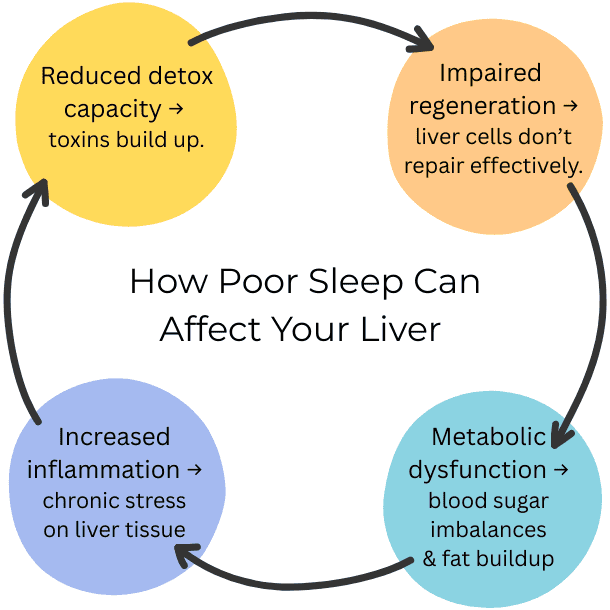
In other words, when your sleep suffers, so does your liver.
The Science of Liver Chronobiology (Full 24-Hour Cycle)
Research in chronobiology—the study of the body’s internal clocks—shows that the liver follows a highly structured 24-hour rhythm. Different functions dominate depending on the time of day:
Please rewrite this sentence.
