
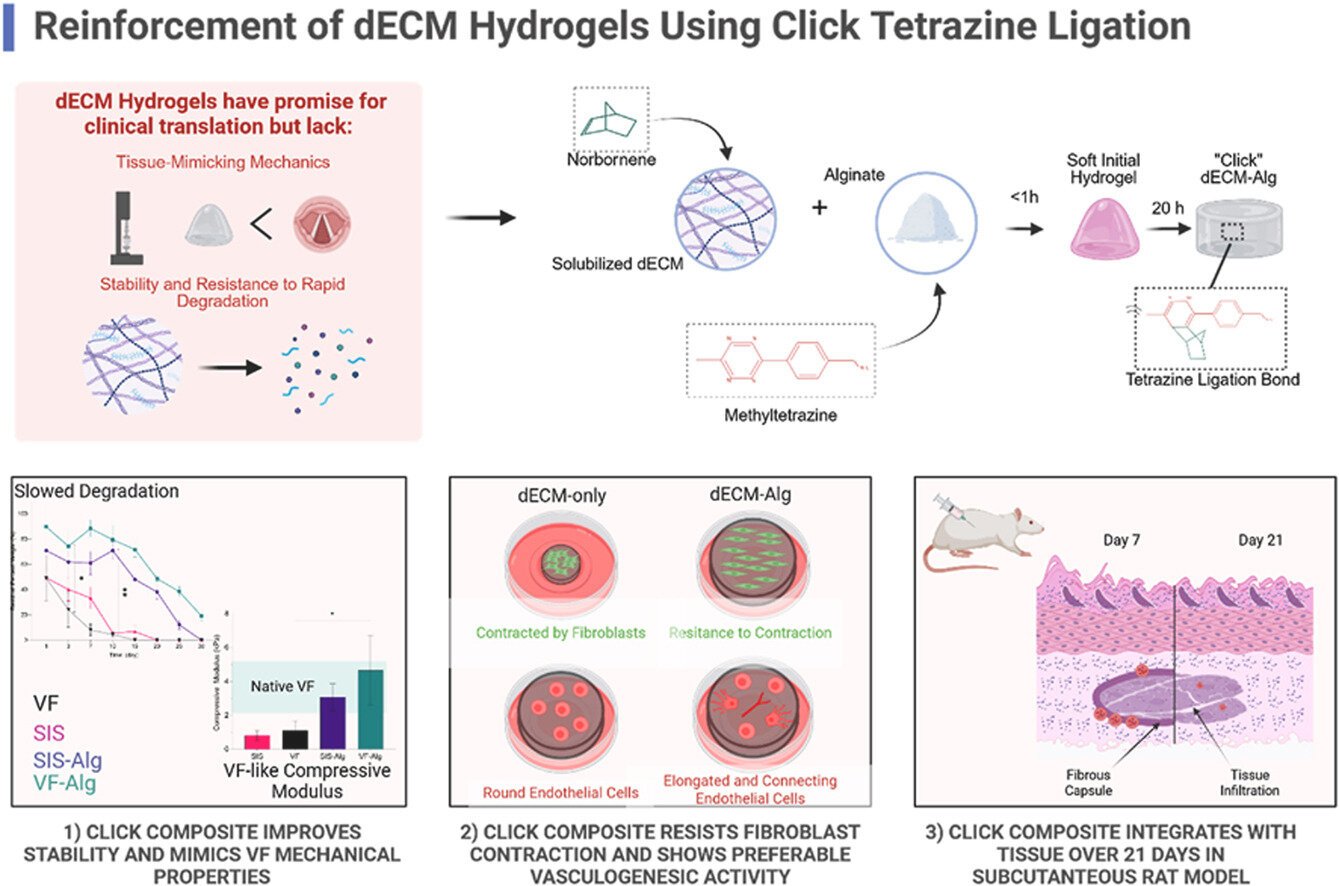
The advancement of medical technology continues to show promise in treating various health conditions, including vocal cord injuries. Researchers at McGill University have developed a new hydrogel that could potentially revolutionize the treatment of voice loss caused by scarring on the vocal cords.
Voice loss is a significant issue for individuals with scarring on their vocal cords, as current injectable treatments break down quickly, requiring repeated procedures that can further damage the delicate tissue. However, the new gel engineered by the McGill University researchers has shown early success in resisting breakdown for weeks in lab and animal tests, outlasting current injectable materials and providing vocal cords with a better chance to heal.
The unique aspect of this gel lies in the process used to create it. The gel is made from natural tissue proteins processed into a powder and converted into a gel using click chemistry. This process acts as a molecular glue, locking the material together and preventing it from breaking down too quickly once injected.
Vocal cord injuries are prevalent among older adults with acid reflux or who smoke, as well as individuals who use their voices professionally, such as singers, teachers, and radio hosts. Approximately one in 13 adults experiences a voice disorder each year, according to the U.S. National Institutes of Health. The impact of voice loss can be particularly devastating for performers whose livelihoods depend on their voices.
The researchers, led by senior author Nicole Li-Jessen, are now looking to test the gel in computer simulations that mimic its behavior in the body. If successful, they hope to progress to human trials, potentially paving the way for a minimally invasive, longer-lasting treatment for voice loss.
For more information on this groundbreaking research, the study titled “Clicktetrazine dECM–alginate hydrogels for injectable, mechanically mimetic, and biologically active vocal fold biomaterials” can be found in the journal Biomaterials (2026) with DOI: 10.1016/j.biomaterials.2025.123590.
McGill University continues to be at the forefront of innovative research and development in the medical field, offering hope for individuals suffering from voice loss due to vocal cord injuries. Stay tuned for further updates on this promising new treatment.