
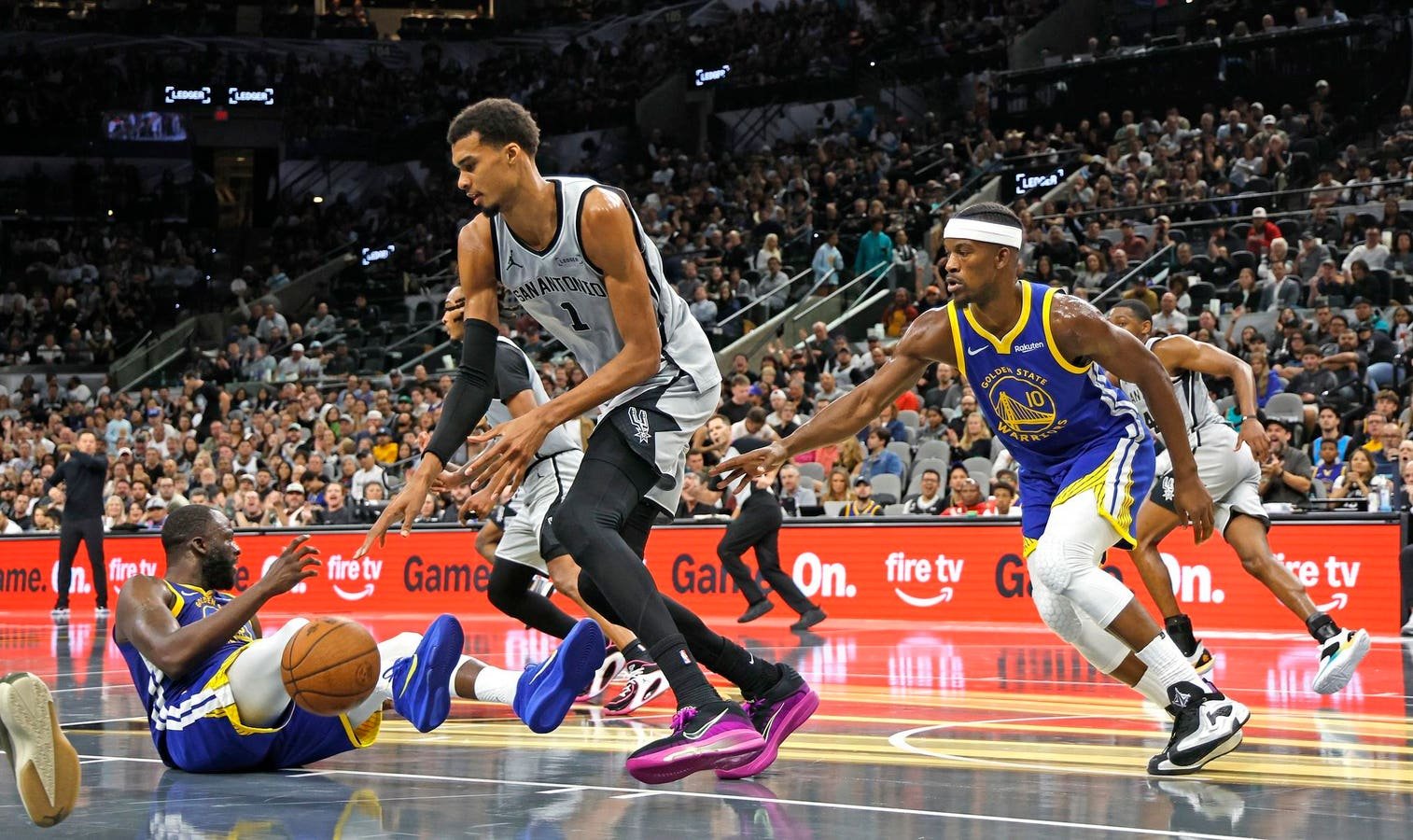
Victor Wembanyama #1 of the San Antonio Spurs has been operating more like a guard than a center of yesteryear. Has that contributed to his recently suffering a calf strain? (Photo by Ronald Cortes/Getty Images)
Getty Images
Don’t have a cow just yet. But calf strains have just taken out not one but two more NBA stars. A left calf strain has left Spurs star center Victor Wembanyama sidelined for a few weeks. And a grade 1 right calf strain means that Memphis Grizzlies point guard Ja Morant will not be right to play for at least another two weeks after he left a November 14 against the Cavaliers game with soreness in that area.
Are Calf Injuries Getting More Prevalent In The NBA?
Of course, calf strains here have nothing do with baby cows being stressed out about politics or something else. A calf strain in this case refers to calf muscles in the lower leg being stretched or torn. Two stars suffering such injuries near the same time could be pure coincidence. But they aren’t the only ones struggling with such injuries. Portland Trailblazer guard Jrue Holiday, Dallas Mavericks center Anthony Davis and Spurs rookie guard Dylan Harper are all dealing with calf injuries right—and left—now as well.
Then there’s what happened during last season’s NBA playoffs. Boston Celtic Jayson Tatum, Milwaukee Buck Jayson Tatum and Indiana Pacer Tyrese Haliburton all suffered Achilles tendon tears.The Achilles tendon is attached to, guess what, the calf muscles. The Achilles tendon is where two becomes one, in the words of the Spice Girls, the tendons from the gastrocnemius and soleus muscles in the lower leg combine to form one tendon. And as I covered in Forbes earlier this year, Haliburton was already struggling with, guess what, a calf strain through much of the NBA Finals before tearing his Achilles tendon in Game 7.
If it seems like the rate of stars getting injured in any way is up this NBA season so far, it is. Ever since the 2023-2024 season when star players played in 87.2% of the games, that percentage has dropped to 82.6% the next season and all the way down to 67.6% this season, according to Tom Haberstroh writing for Yahoo Sports. He also pointed out that number of games missed by star players during the opening month of the season has gone from one out of every nine or 10 games to one out of every three. Of the first 12 games of this season, star players have participated in just 56% of them. Although not all of these absences have been due to calf injuries, calf injuries have still factored in prominently.
Are The Style And Tempo Of Play Contributing To Calf Strains?
If you are running around looking for explanations about what’s going on, one possibility is all the running around that going on during the games these days. The game does look quite different from it did back in the 1990s when defense was allowed to be more physical and many possession seemed to be more grind-it-out affairs with more post and mid-range play.
Today’s games seem to be more frenetic with a greater reliance on three-point shots, players spaced out more widely across the court and increases in the per game number of possessions and scoring (100.5 points per game so far this season compared to 88.9 in 1998-1999 season). And although the NBA has only tracked player speed and distance traveled per game only since the 2013-2014 season, these numbers have hit highs this season with the average speed being 4.43 miles per hour and the average distance per game being 34.3 miles, based on ESPN research.
ESPN’s Anthony Slater also quoted Golden State Warriors head coach Steve Kerr as saying, “Across the league, everyone understands that it’s easier to score if you beat the opponent down the floor, get out in transition, but when everybody’s doing that, the games are much higher-paced.” Kerr continued with, “Everyone has to cover out to 25 feet because everybody can shoot 3s. We have all the data. Players are running faster and further [than] before.”
Such changes may in turn put different stresses on different parts of the body. Running around and cutting more to get open to attempt a three point could in turn put more stress on the calf muscles. You contract your calf muscles whenever you point your foot and toes downwards. This motion is called plantar flexion. You do it whenever you plant your foot and then push-off the foot to launch into running, change directions when running or jump.
Are Changes In Player Roles Contributing To Calf Injuries?
Guard Ja Morant #12 of the Memphis Grizzlies, who is out with a calf strain, watches from the bench during the third quarter against the Cleveland Cavaliers at Rocket Arena on November 15, 2025 in Cleveland, Ohio. (Photo by Jason Miller/Getty Images)
Getty Images
Another thing that you have to roll into the discussion is changing player roles. Positions on a court used to be more clearly defined. A center would stay around the basket both on offense and defense, focusing on rebounding, blocking shots and taking shorter, higher percentage shots. Power forwards would stay reasonably close to basket. Small forwards would roam more than the big men. Shooting guards would, huess what, shoot. And point guards would be responsible for bringing the ball up the court,
Nowadays, these positions are a lot more blurred. You’ve got centers and power forwards now handling the ball like point guards and shooting three pointers like shooting guards. These big bodied folks are playing more like smaller bodied folks with more running and cutting. The seven-foot-four-inch and 236 pound Wembanyama literally embodies this change. This clearly-would-have-been-a-center-in-the-1990’s is averaging close to five three point field goal attempts this season.
All of these factors may be contributing to calf injuries in various ways. The increased movement of all players on the court could lead to more running and cutting, particularly for larger and heavier players. This increased activity can result in additional force being applied to the calf muscles during plantar flexion.
Are Players’ Pre-NBA Careers Contributing To Calf Strains?
It’s important to consider the playing careers that NBA players have before entering the NBA. Many players start specializing in basketball at a young age, participating in professional camps and leagues. This early specialization can lead to imbalanced development and potentially increase the risk of injury. The wear and tear on players’ bodies over the years from such intense training should not be overlooked.
College basketball has also evolved significantly since the 1990s, with fewer players spending multiple years in college. This shift in player development and conditioning could impact the risk of injuries, including calf strains.
Are Shoes Contributing To Calf Strains?
Changes in lower extremity injury rates may be linked to advancements in shoe technology. Sneaker manufacturers have introduced new designs and features to enhance performance and comfort. The shift towards low-top sneakers for improved ankle flexibility may have unintended consequences, such as increased calf injuries. More research is needed to understand the impact of these shoe changes on injury risk.
To address the issue of calf strains and prevent future injuries, basketball teams should invest in studies and data analysis. Understanding the factors contributing to these injuries is essential for player health and team success. The cost of preventing injuries is far less than dealing with the consequences of having key players sidelined due to calf strains.
