
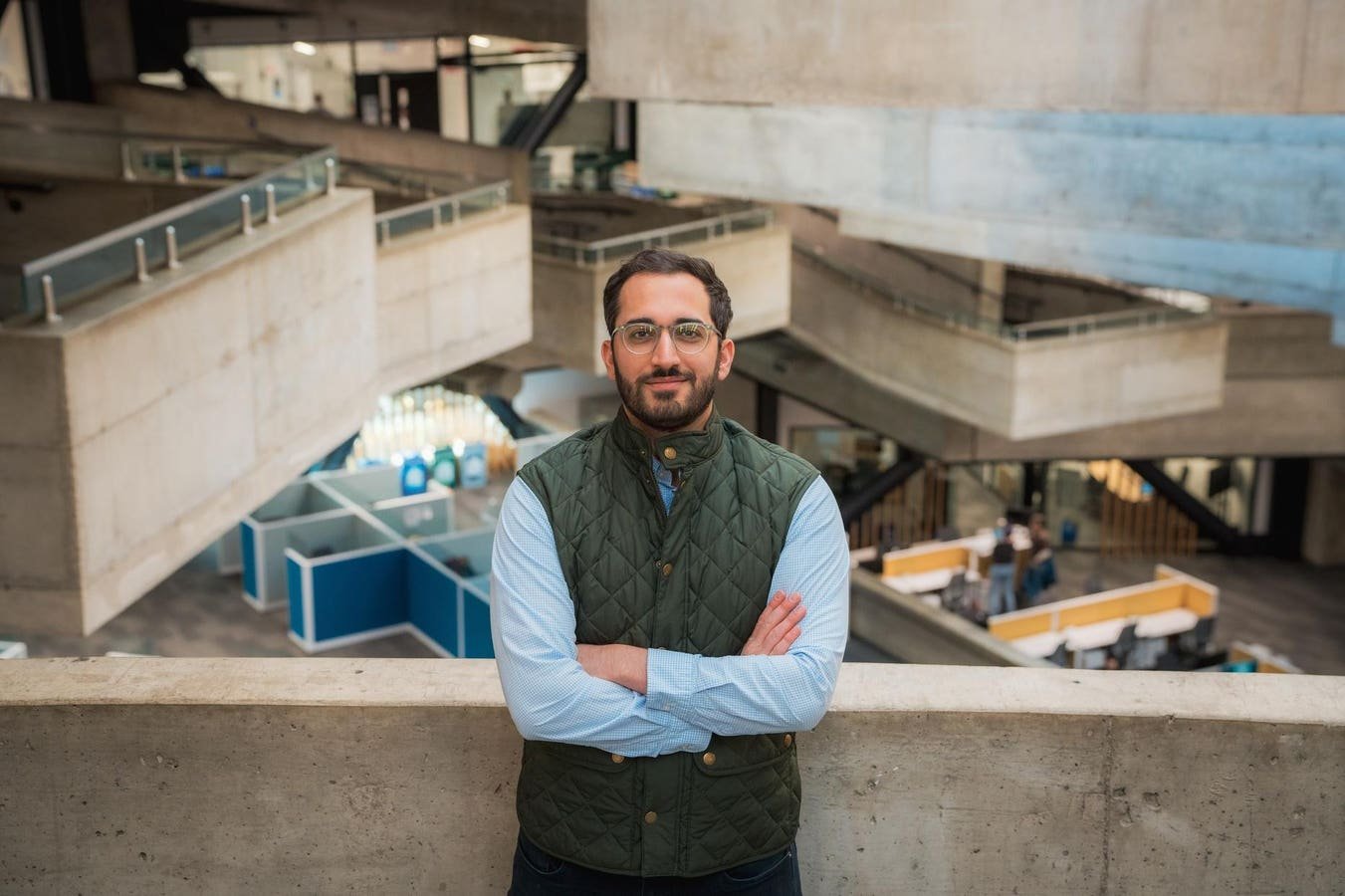
Profluent founder Ali Madani
jin han
Profluent has raised $106 million to scale up use of its AI models for biology in drug development and agriculture.
Ali Madani initiated his exploration of AI’s potential in biology back in 2020, even before the advent of ChatGPT. As a machine learning scientist at Salesforce, he was involved in the launch of ProGen, a moonshot project aimed at designing novel proteins with generative AI. Madani envisioned applying the same architecture used for English to biological languages like proteins, stating to Forbes, “The same architecture used for English, you can use for biological languages like proteins.”
In 2022, Madani departed from Salesforce and joined forces with Alexander Meeske, the head of a research lab at the University of Washington, to transform that vision into reality. Today, Profluent, Madani’s Emeryville, California-based startup, utilizes AI models that allow scientists to articulate the specific properties desired in a protein in human language (such as stability or ease of manufacturing) and then generate a DNA recipe to produce that protein.
Holding a Ph.D. from the University of California, Berkeley and serving as the lead author of a Nature Biotechnology paper on ProGen, Madani believes that focusing on proteins could unlock revolutionary new drugs. Proteins, being more complex than the small molecules underpinning many existing drugs, offer the potential for innovative treatments like gene therapies. Moreover, this approach could lead to advancements in agriculture, facilitating the creation of more resilient and sustainable crops.
“The proposition of making biology programmable is going to enable blockbuster drugs, and solutions across therapeutics, diagnostics, and agriculture—and it’s going to require a lot of capital,” Madani affirmed.
In line with this vision, Profluent announced on Wednesday that it had secured $106 million in new venture funding, with Jeff Bezos’s Bezos Expeditions and Altimeter Capital as lead investors, bringing the total investment to $150 million. With this latest financing, Profluent’s valuation is nearing $1 billion. The company’s commercial partners include Revvity, an $11 billion (market cap) biotech; Corteva Agrisciences, the agricultural spinoff of DuPont; and VC-backed Ensoma, focused on treatments for genetic diseases and cancer.
“The proposition of making biology programmable is going to enable blockbuster drugs … and it’s going to require a lot of capital.”
While companies like Recursion have long been striving to incorporate AI into drug discovery, the journey has proven more challenging than initially anticipated. However, given the high failure rate of new drugs (90%) and the exorbitant costs associated with their development, an increasing number of companies are turning to AI-driven protein design to address this challenge. Profluent faces competition from industry giants like Isomorphic Labs, the offshoot of Google’s AI research lab DeepMind, and startups such as Xaira Therapeutics, which emerged from stealth last year with $1 billion in funding.
Profluent’s objective goes beyond utilizing AI to identify existing proteins, the conventional approach in drug development, aiming to custom-design entirely new proteins tailored to individual patient needs.
As of now, Profluent has established a database named Protein Atlas, comprising 115 billion unique proteins, touted as the largest protein data resource globally. Leveraging this vast data pool alongside enhanced computational power is expected to facilitate the development of more advanced models—a concept referred to as “scaling laws.” Earlier this year, Profluent demonstrated the effectiveness of scaling laws in protein design models. Recently, the company introduced a new foundational model, dubbed Profluent E-1, providing evolutionary context.
For the latest healthcare news, sign up for Forbes’ InnovationRx newsletter.
“One of the reasons Jeff [Bezos] was interested is that we have discovered scaling laws” apply to biology, Madani remarked. “As you gain more and more data, the models get better and better.”
Investor Jamin Ball, a partner at Altimeter Capital, who crossed paths with Madani around 18 months ago and developed a relationship during strolls at a bio conference in San Diego last year, emphasized the immense potential in transitioning from serendipity in drug discovery to bespoke design. “We believe the next frontier in AI will be biology and drug discovery,” Ball stated.
“We are still at a nascent stage,” Madani acknowledged, likening the current state of AI-enabled biology to the early days of the Internet. “If we can have a machine that can truly make biology programmable, we will have a conveyer belt of blockbuster solutions.”
MORE FROM FORBES
Could you please rewrite this sentence for me?