
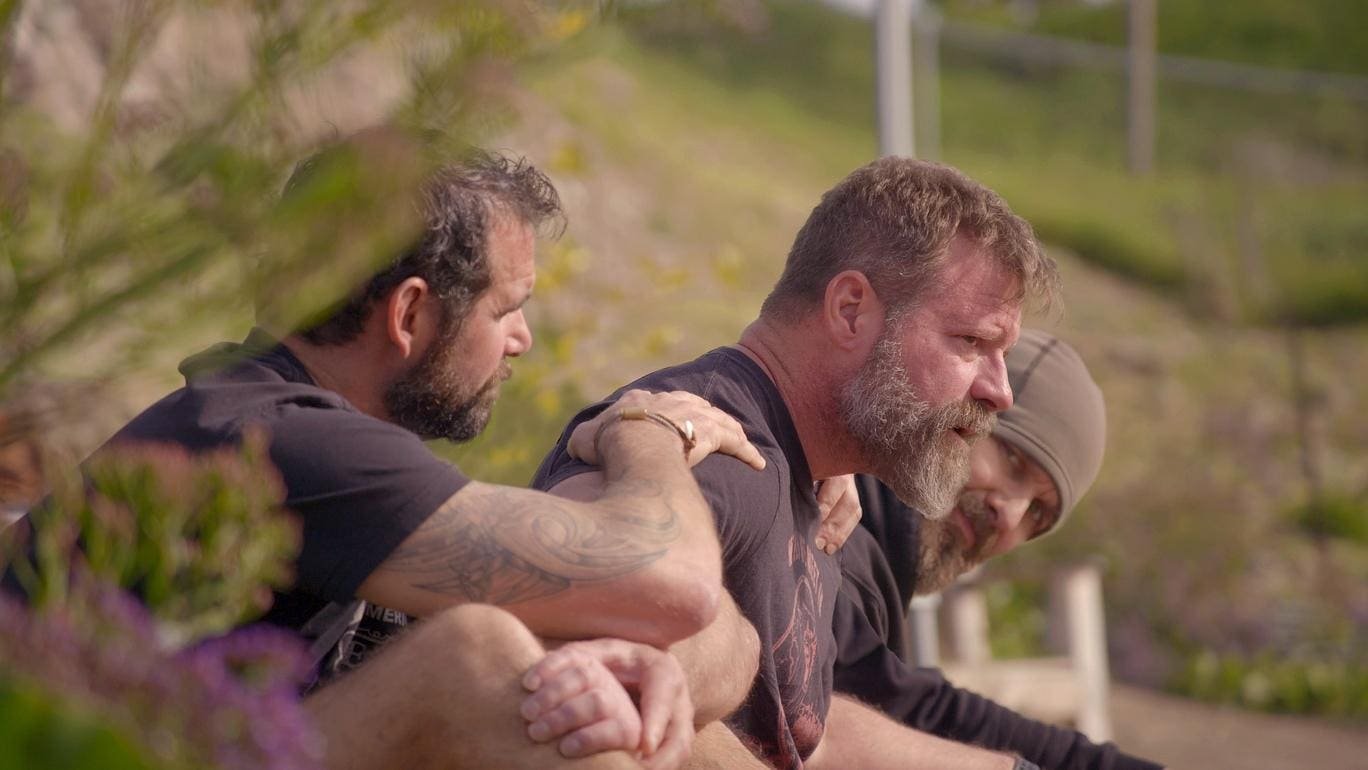
From “In Waves and War” (pictured left to right): Marcus Capone, Matty Roberts and DJ Shipley
Courtesy of Actual Films
For some military veterans, psychedelics is the last resort in treating those who have suffered the debilitating effects of post-traumatic stress disorder. In the documentary In Waves and War, which began streaming on Netflix on November 3, 2025, a group of Navy SEALS are at the breaking point—some even contemplating suicide–when they decide to travel to a clinic in Mexico to undergo psychedelic-assisted ibogaine therapy to combat treatment-resistant PTSD, traumatic brain injuries, and severe depression. Their journey toward healing becomes the central focus of the story, which is gaining traction among lawmakers. Recently, the film was screened for the Texas State legislature, who voted to approve $50 million in state funding for ibogaine drug development trials.
Directed by Jon Shenk and Bonni Cohen (Athlete A, Lost Boys of Sudan, Audrie & Daisy), the film proved to be the most complex project the duo ever worked on as well as their most artistically fulfilling. Shenk and Cohen took a break from their schedule to discuss how the project began, its creative evolution and the challenges involved in bringing the film to fruition.
This Q&A has been edited for conciseness and clarity.
Iris Dorbian: How did this film project begin?
Jon Shenk: In 2019, Executive Producer Jamis MacNiven introduced the filmmaking team to Amber and Marcus Capone. Marcus, a retired Navy SEAL, and his wife Amber, had begun speaking publicly about the psychedelic therapy protocol he underwent as a last-ditch effort to find relief from the symptoms of traumatic brain injury, treatment-resistant PTSD, anxiety, and depression—conditions that stemmed from his 13 years of near-constant deployments in Afghanistan and Iraq.
Because the SEAL community is famously private, building trust took time. We wanted to understand the culture from the inside, so we spent months interviewing veterans who had traveled to Mexico for ibogaine and 5-MeO-DMT therapy. Eventually, we decided to focus on the Capones and a close-knit group of SEALs with whom Marcus had trained and served.
We came to see that a powerful motivating force for these veterans was their desire to help one another. In the field, they learn that no one gets left behind. In the film, that ethos drives a new kind of battle: confronting the suicide epidemic among veterans.
Dorbian: What made you choose this set of veteran Navy SEALs?
Bonni Cohen: Amber warned us early on that we’d need to find SEAL veterans who didn’t want to be in the film. She explained that SEAL culture is deeply skeptical of anyone who talks openly about their experiences in the military. Respect tends to go to those who stay humble.
It was also important for us to work with someone who hadn’t yet undergone psychedelic therapy, so we could document the transformation firsthand. In the film, we meet DJ Shipley and Matty Roberts alongside Marcus Capone. At first, Matty was hesitant to participate in either the treatment or the filming, but he ultimately agreed to both. The journey we captured is raw, dramatic, and deeply personal.
Dorbian: Were there any challenges making this documentary? If so, what were they and how were they resolved?
Shenk: This was a challenging film to make for two main reasons. The first was access and trust. Making a film within a community that doesn’t typically open its doors to outsiders was a challenge in itself. It required patience, humility, and a willingness to take risks. There were many times when we would pack up our gear, assemble a crew, and board a plane—often with little more than a hope and a prayer that someone would agree to meet with us and allow us to film. Sometimes it worked, sometimes it didn’t, and we had to be okay with that uncertainty.
The second major challenge was figuring out how to portray what the SEALs actually experienced during their psychedelic treatments. We wanted to represent those moments as accurately and respectfully as possible, but of course, there was nothing we could film directly. That limitation ultimately led to one of the film’s creative breakthroughs: using animation to depict the ibogaine experience.
Dorbian: What’s your end goal with this documentary? What is the message you most want to convey?
Cohen: At its heart, this film is about connection. We want it to remind people that trauma touches all of us, and that for some, these life-changing therapies can offer a way back—toward healing, toward hope, toward themselves. Through intimate human stories, we aim to show how the ripple effect of one person’s transformation can extend to a family, a community, even the culture at large.