
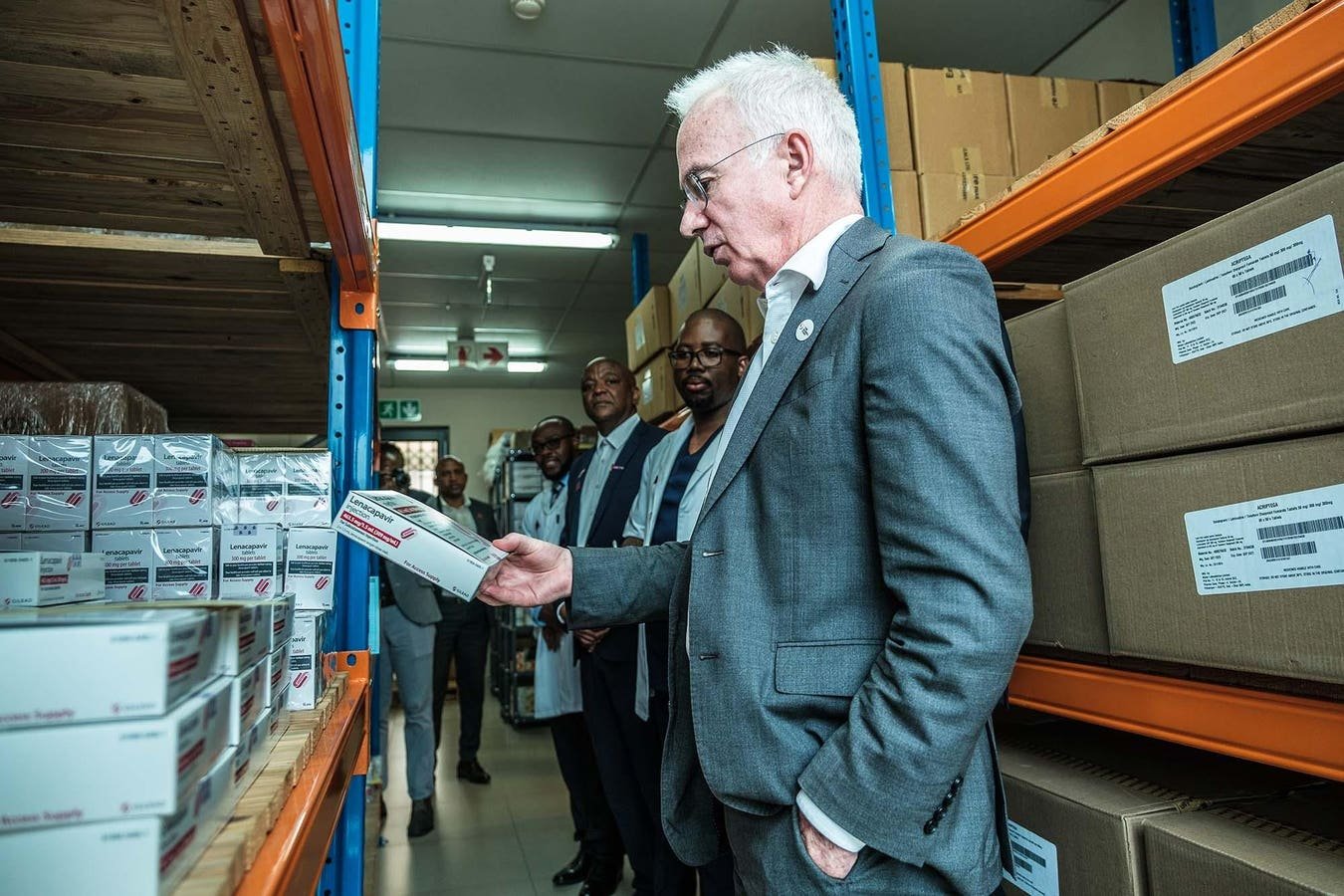
Global Fund Executive Director Peter Sands inspects boxes with lenacapavir during a visit to Eswatini’s Central Medical Stores.
The Global Fund/Brian Otieno
When I entered Eswatini’s Central Medical Stores that morning, the first thing that caught my eye were the neatly stacked boxes.
They were arranged in tall, orderly columns on pallet racks in the center of the warehouse — plain cardboard boxes, meticulously labeled, appearing like any other medical shipment. Warehouse staff moved around them with a sense of purpose, inputting data, conducting routine checks, carrying out the essential tasks that keep a healthcare system functioning. There was nothing extraordinary about these boxes that would indicate they held something groundbreaking and were the first of their kind in Africa.
However, within those unassuming boxes lay something remarkable: the initial shipment of lenacapavir to arrive on the continent — a biannual HIV prevention injection developed by Gilead Sciences that has the potential to redefine how individuals protect themselves from infection. I arrived just days after the completion of the receiving process by the team.
The enthusiasm among the warehouse staff was understated yet palpable. Teams from the Ministry of Health, the National Emergency Response Council on HIV and AIDS (NERCHA), AIDS Healthcare Foundation Eswatini (AHF Eswatini), the Global Fund, the Children’s Investment Fund Foundation (CIFF), along with Gilead, the U.S. President’s Emergency Plan for AIDS Relief (PEPFAR), and other collaborators, had spent years preparing for this moment — strengthening systems, devising implementation strategies, aligning protocols, and ensuring that supply chains were well-prepared. Eswatini, a nation with one of the highest HIV prevalence rates globally, has consistently shown leadership in the HIV response, a spirit that was evident in the warehouse.
These boxes symbolized more than just a delivery; they marked a significant milestone for a country that has faced the worst of the epidemic and has worked tirelessly to reverse its impact.
Later that day in Manzini, I witnessed firsthand the implications of this milestone.
A truck carrying the first delivery of lenacapavir crosses the border into Eswatini.
The Global Fund/Daniel Toro
The LaMvelase Clinic, operated by AHF Eswatini, is the largest treatment center in the country and a bustling hub for HIV testing, treatment, and prevention. By mid-morning, the courtyard was bustling with activity: schoolgirls in uniforms, young men in work attire, mothers with toddlers, and members of key populations who often face stigma elsewhere. The clinic has become a trusted sanctuary — a rare space where individuals can seek care without fear of judgment.
In one consultation room, a nurse described her typical day. She attends to numerous clients with diverse needs: HIV tests, STI screenings, family planning, counseling. Many individuals come to the clinic because of its reputation for providing compassionate, confidential care and offering viable prevention options.
What struck me the most was the deep understanding the staff had of the factors influencing people’s decisions. In Eswatini, as in many other places, daily oral prevention pills can be challenging to conceal. For individuals facing gender-based violence or power imbalances in relationships, requesting a partner to use a condom can be risky or simply unfeasible. Stigma alone can deter someone from carrying medication at all.
In this context, a long-acting injectable administered twice a year is not just convenient — it is empowering. It provides individuals, particularly young women, with a discreet, private means of self-protection.
Upstairs, Dr. Nkululeko Dube reflected on the country’s progress. He recollected the times when antiretrovirals were scarce, hospital wards were filled with individuals succumbing to treatable infections, and families were selling assets to procure medicines that often arrived too late. Presently, Eswatini has surpassed the UNAIDS 95-95-95 targets and has established one of the most robust HIV treatment programs globally.
However, he also emphasized how precarious progress can be. A small segment of the population remains unaware of their HIV status or is not yet receiving treatment. Without vigorous prevention efforts, this existing gap could lead to new infections and jeopardize the gains made over the past decade.
That is why the unassuming boxes in the warehouse hold such significance.
As I departed AHF’s clinic, I contemplated the journey those vials would embark on: from the Central Medical Stores to facilities across the country, from trained professionals to individuals making choices about their futures, from a scientific breakthrough to a tangible reality.
Warehouse workers inspect a delivery of lenacapavir at Eswatini’s Central Medical Stores, the very first such delivery to the African continent.
The Global Fund/Daniel Toro
Eswatini is not alone in this moment. Momentum is building across sub-Saharan Africa. Zambia had also recently received initial shipments, and seven other countries are gearing up to receive their first deliveries of lenacapavir between now and early next year — a powerful display of regional leadership and a notable departure from the historical norm where the most affected countries received innovations last rather than first.
For the first time, an advanced HIV prevention tool is being introduced in low- and middle-income countries almost simultaneously with high-income nations. This in itself marks a breakthrough, as previous HIV prevention drugs took an average of five years to reach these settings after their efficacy was initially demonstrated.
With the arrival of these initial doses, a new prospect is emerging: a future where scientific advancements reach individuals globally, not years later, but now.
Nevertheless, this juncture is also a litmus test. Alongside PEPFAR, we have set an ambitious objective: to provide long-acting pre-exposure prophylaxis (PrEP) to up to two million people within the next three years. Achieving this target would significantly reduce new infections in countries bearing the highest burden. However, without sustained investments from donors, governments, and partners, this momentum could falter just as we approach what could be a pivotal step toward ending AIDS.
Preventing infections today is far more cost-effective than treating them over a lifetime. It fortifies health systems, expedites the transition to sustainable domestic funding, and safeguards the remarkable progress achieved by countries like Eswatini. Yet, success hinges not only on financial support but also on trust — trust in clinics to deliver stigma-free care, trust in healthcare workers to maintain a steady supply of medications, and trust in global partners to stay committed.
What lingers with me from Eswatini is the image of those unassuming boxes in the warehouse — seemingly ordinary on the outside, brimming with potential within. I carry with me the dedication of the nurse in Manzini, the determination of Dr. Dube, the professionalism of the warehouse team, and the leadership of the Ministry of Health and NERCHA.
If we take decisive action now — collaboratively, boldly, and with communities at the forefront — the moment I witnessed in Eswatini may one day be hailed as the turning point when the world embarked on the journey to finally eradicate AIDS: the moment when the aspiration of ending AIDS transitioned from a distant goal to an attainable reality.
