
Our skin is a remarkable organ that shields us from various external stresses, such as friction, cuts, and impacts. One of the most intriguing features of our skin is its ability to regenerate and heal itself. But have you ever wondered where this incredible healing power originates from?
A recent study published in Nature Communications sheds light on this question. Led by Kaelyn Sumigray, Ph.D., and Stefania Nicoli, Ph.D., an interdisciplinary team uncovered a fascinating discovery about the role of skin stem cells in the early stages of embryonic development. They found that these stem cells play a crucial role in forming a protective layer of skin that enhances the healing process as the embryo matures.
The researchers conducted their study using zebrafish embryos, which share similar skin organization with human embryos. They focused on the thin layer of cells lining the zebrafish fin folds, which eventually develop into fins. By studying these structures, the team uncovered a mechanism that enhances skin resilience and accelerates tissue repair.
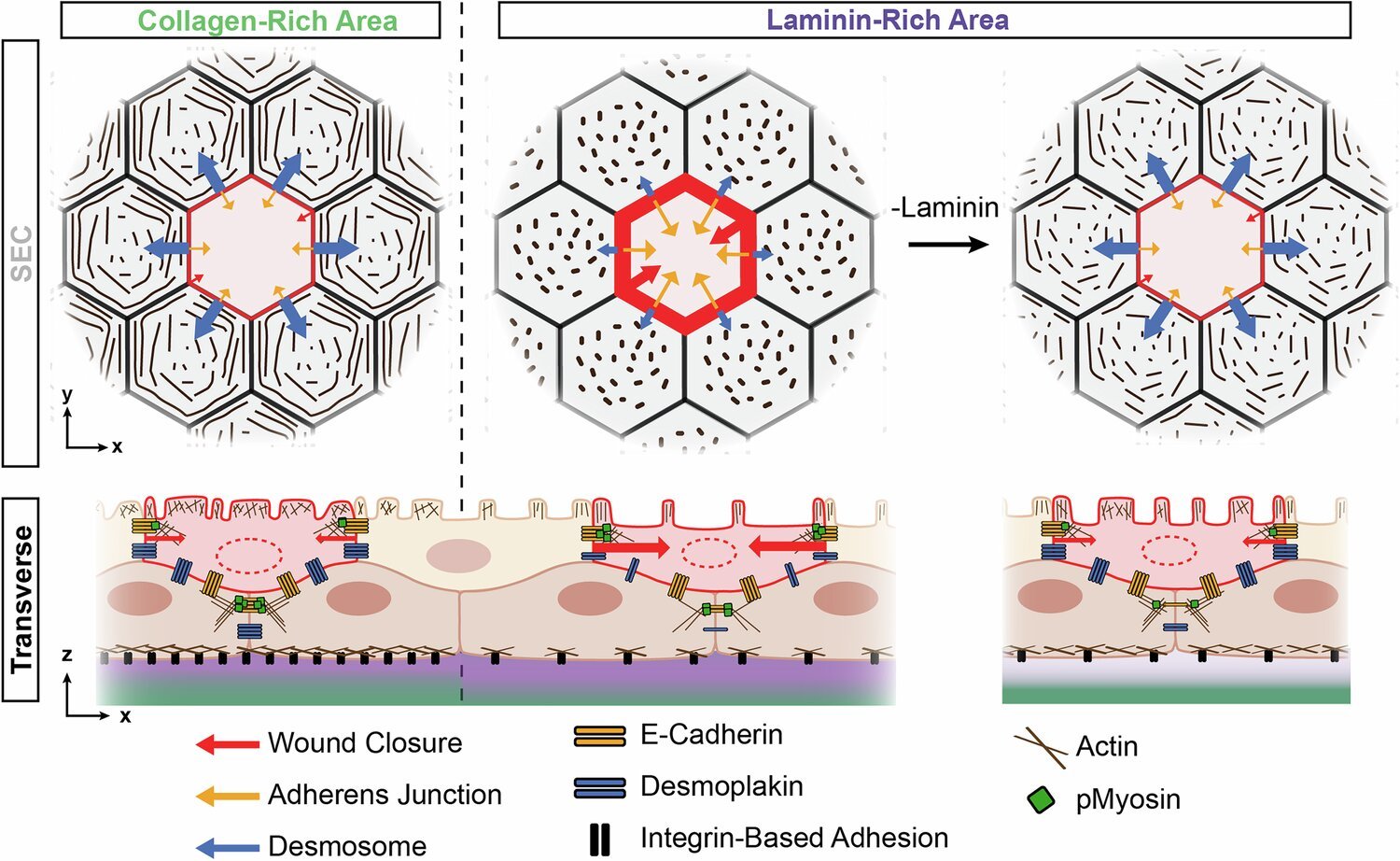
One of the key findings of the study was the identification of two proteins—collagen and laminin—that are expressed by basal epidermal stem cells (BECs) in specific patterns along the fin fold. These proteins contribute to the extracellular matrix, a network of proteins and carbohydrates that support the cells in tissues. The researchers found that BECs promoting laminin reduce desmosome formation, weakening cell-to-cell adhesion and facilitating tissue mobility during injury. On the other hand, BECs promoting collagen increase desmosomes, strengthening cell junctions and impeding skin repair.
The collaboration between these two pathways allows the embryo to develop a resilient protective layer and quick healing ability. This mechanical logic employed by stem cells highlights a novel function that could have implications for tissue engineering and regenerative medicine.
The researchers also compared their findings in zebrafish embryos to a human epidermal model. They found that collagen and laminin matrices influence human skin cells in a similar manner, suggesting that the mechanism identified in zebrafish could be applicable to human skin as well.
This study opens up new avenues for research on intratissue communication and offers potential strategies for enhancing tissue repair through tissue engineering and regenerative medicine. The insights gained from this study could lead to the development of innovative skin healing methods, personalized mechanical shields, and advancements in organ repair and skin transplants.
The implications of this research are broad, and the potential to guide stem cells towards creating protective tissues holds promise for the future of regenerative medicine. By understanding the intricate mechanisms involved in skin resilience and repair, researchers are paving the way for transformative developments in healthcare.
In conclusion, this study provides valuable insights into the early stages of skin development and the role of stem cells in tissue repair. The discoveries made by Sumigray, Nicoli, and their team offer a new perspective on the healing process and lay the foundation for future advancements in regenerative medicine.